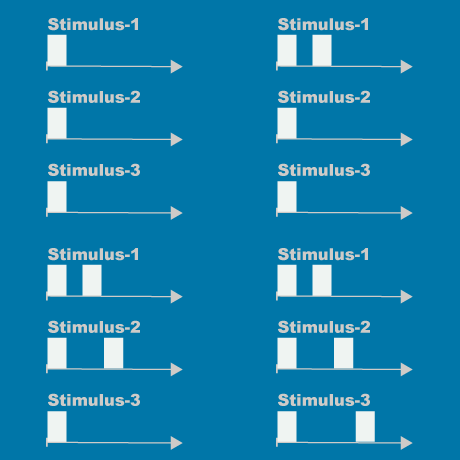
According to Reber & Reber (2001) the word discrimination can have at least three meaning.
Cognitive neuroscience usually concerns itself with two of them. These are,
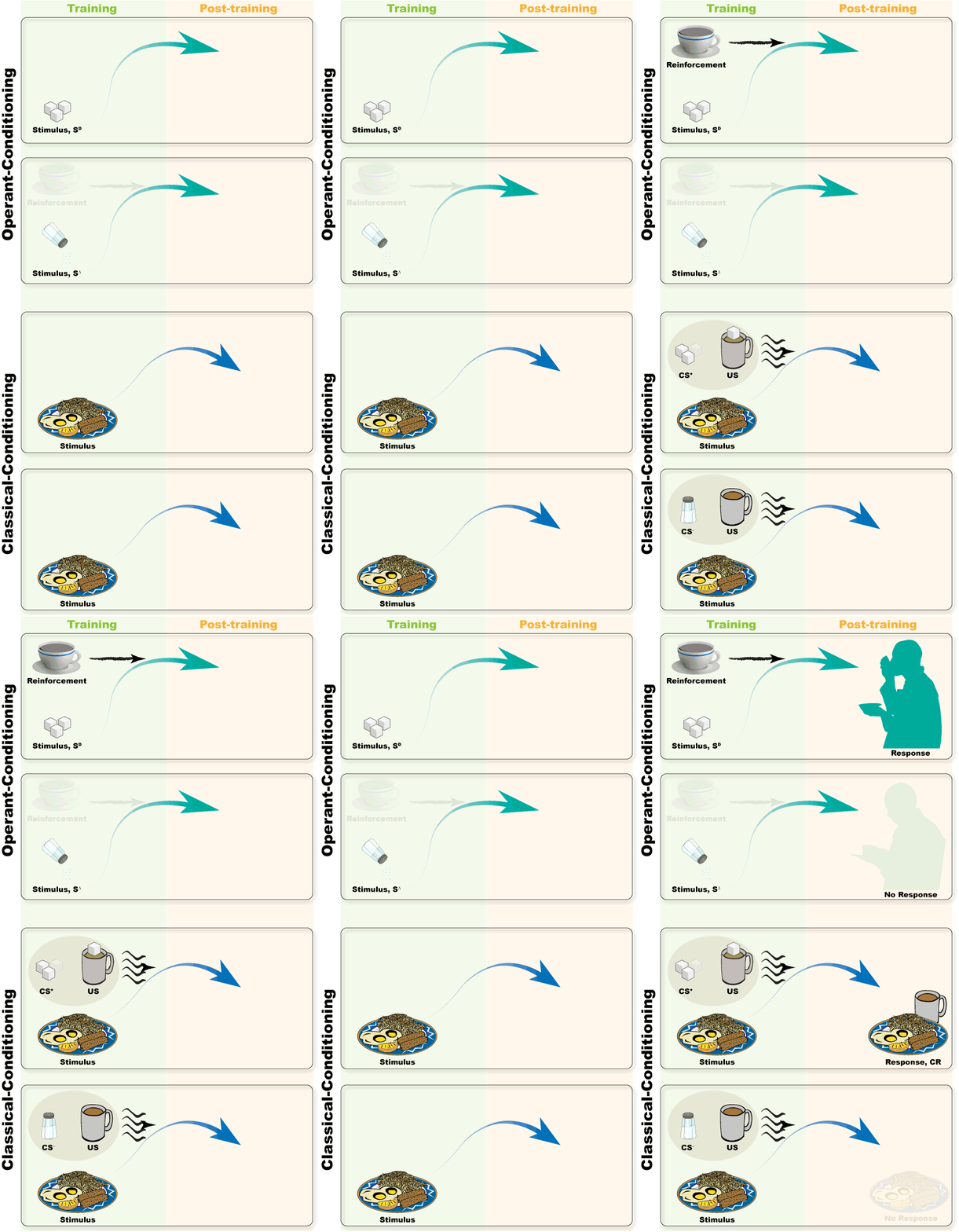
- "The ability to perceive differences between two or more stimuli." (Reber & Reber, 2001, p. 205)
This may be viewed as a class of experimental procedures collectively called, discrimination training procedures.
The operant-conditioning experiments and the classica conditioning experiments belond to this class.
- "The capacity to distinguish between stimuli." (Reber & Reber, 2001, p. 206)
This is the definition in the context of perception and psychophysics. One of the 'distinguishing factor' is the idea of threshold.
Threshold as a statistically determined point on a stimulus continnum can be either
absolute threshold or subjective threshold. Differential threshold
is the point where the observer detects difference between two stimuli.
Another form of threshold is the minimum stimulus energy sufficient to excite a neuron.
When the term is used to describe a training procedure whereby an organism learns to respond
differentially to different stimuli, the question of perceptual learning☨ arises indirectly.
Generally, "a priori assumption is made that the organism does perceive the differences
between the stimuli but does not react differently toward them because it has never been
reinforced for treating them differently." (Reber & Reber, 2001, p. 206)
- Reber, A.S., & Reber, E.S. (2001). The Penguin Dictionary of Psychology (3rd ed.).
England, London: Penguin Books Ltd.
- ☨the organism's learning to detect the physical differences between the stimuli themselves.
Wikipedia article on
Discrimination
.