_ Applying Association

Association

What is Association?

The long history of the usage of this term has resulted in number of specialized uses (Reber & Reber, 2001). This discussion will be concerned with two of these.
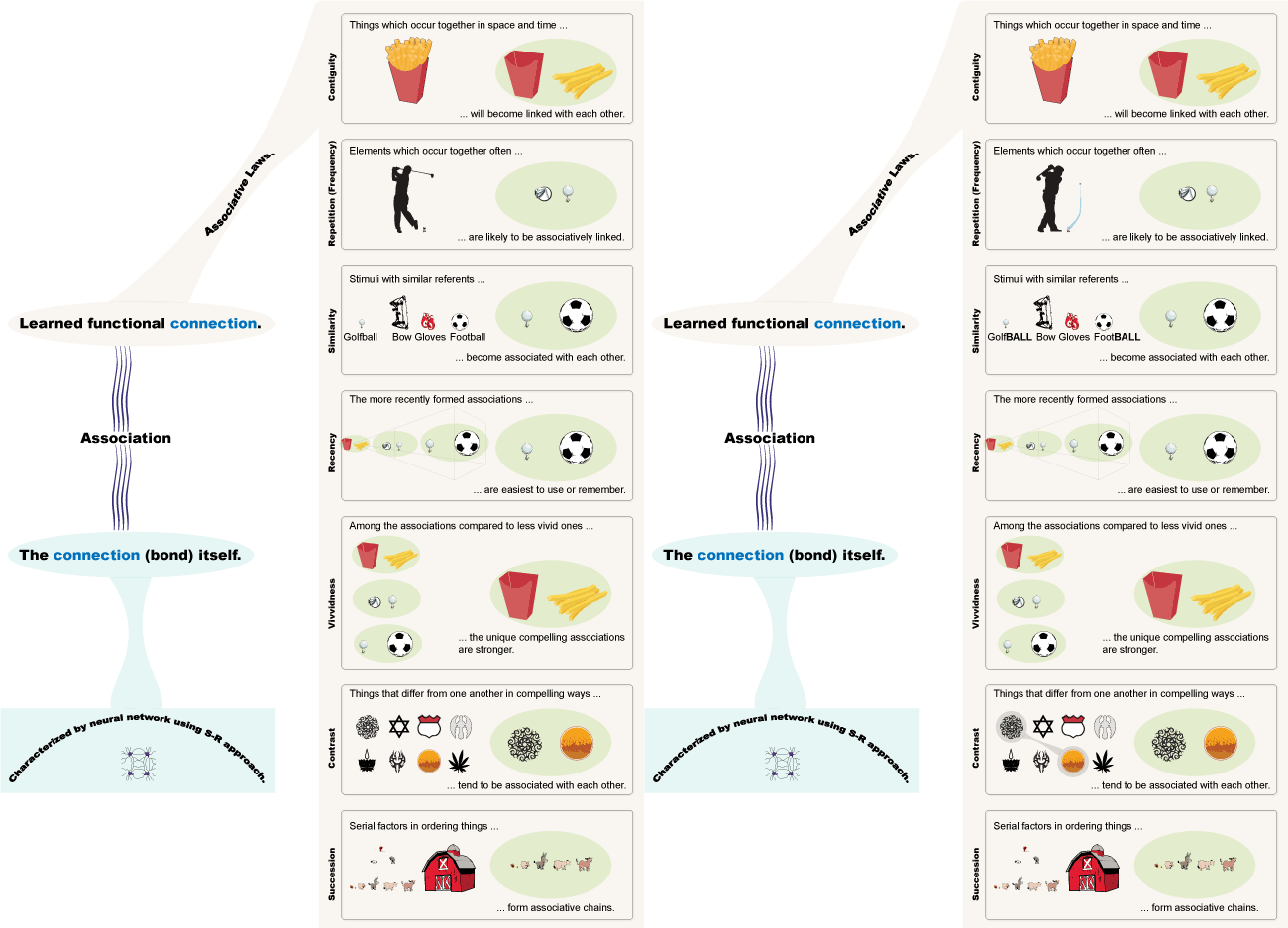
  1. Most commonly, any learned, functional, connection between two (or more) elements. Associative laws are the governing rules/mechanisms for the connection.
  2. The bond or the connection itself (implied above). Theories of learning in the Behaviorist school revolves around the connection/association between stimuli (S) and responses (R), S-R connections☨☨.
    
When the term is used to describe a learned function the manner in which associations are formed are governed by a number of theoretical generalizations, the cover terms for this is associative laws (Reber & Reber, 2001, p. 58).
    
It should be noted that although many of the associative laws are derived from early Associationism which are not founded on hard experimental data but can nevertheless have compelling intuitive validity (Reber & Reber, 2001)
  • Reber, A.S., & Reber, E.S. (2001). The Penguin Dictionary of Psychology (3rd ed.). England, London: Penguin Books Ltd.
  • Associationism is a theoretical exercise of
    • precisely identifying the elements (e.g. ideas, acts, images, stimuli and response, memories)
    • specifying the associative laws underlying their connection.
  • ☨☨The S-R approach aims at understanding the nature of the link practically characterized in various ways, from simple neural pathways to abstract propostional networks. This notion continue under the Connectionist school.
  • The referent entity in the real world is indicated or picked out by word, phrase or expression. Strictly, only concrete objects or events can be considered as referents.
    
Wikipedia article on 
Association
.

    

The term 'association' will depend on the context.

  • In terms of a process it is the learned function goverened by associative laws to connect elements.
  • In terms of the result of the process it is the connection between the elements.

Chris Huyck et. al's NEAL Three-Way Association

PRINCIPLES BEHIND THE APPROACH
  • Assume a controlled association, i.e. precise instructions given to put boundaries on the kind of association.
  • Assume a short-latency association, i.e, immediate association.
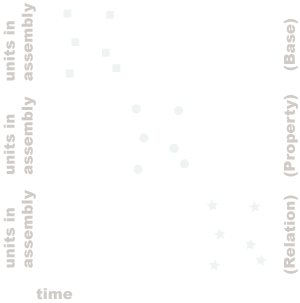
  • Response for a given referent as a stimuli is the state of a cell assembly.
  • The association is among three referents.
  • In a 3-way association of one-word referents there are three categories of referents: subject (base), object (property), and predicate (relation).
  • Also, assume the presence of acquired knowledge.
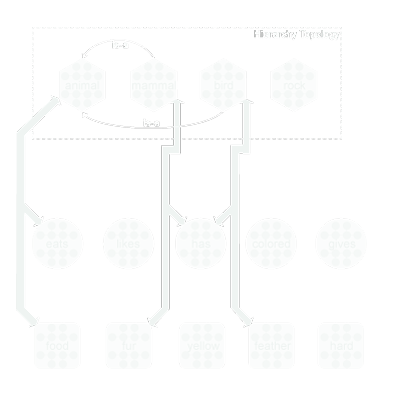
    • The awareness of set of base units (e.g. animal, mammal) and the set of how they might be related with each other (e.g. animal is a mammal).
    • The awareness of the set of possible properties (e.g. food, fur) of base units.
    • The awareness of the set of possible relations of any base unit with a property.
    • The awareness of the relation of a base units with its property, i.e, the association.
Next ›‹ Previous
NETWORK ARCHITECTURE
  • A cell assembly constitutes a neuron population such that its units are interconnected.
    • The consequence of the activities of the units within a population is a cell assembly state.
    • Each cell assembly represents a functional unit for a referent.
  • Each cell assembly for every unit in the set of base units are connected on the basis of the set of how the base units are related. This constitutes the hierarchy topology.
  • The cell assemblies of all the referents and its connections constitute the association topology.
Next ›‹ Previous
HOW IT WORKS
For a given background knowledge (i.e. acquired knowledge) spikes from units within a cell assembly for a base-referent corresponds to those relation and property-referents.
BEST USED....
  • To create a spiking neural network system of three components such that they represent the function of associating one with another via the third component.
  • To have packets of spike trains (at least three packets) such that one follows another.
RESULT
Next ›‹ Previous

Get nmcog

Install nmcog
CLOSE